The Project's Strategy for Building National Capabilities for Coastal Zone Management
Establishing Knowledge Foundations for ICZM Concepts:
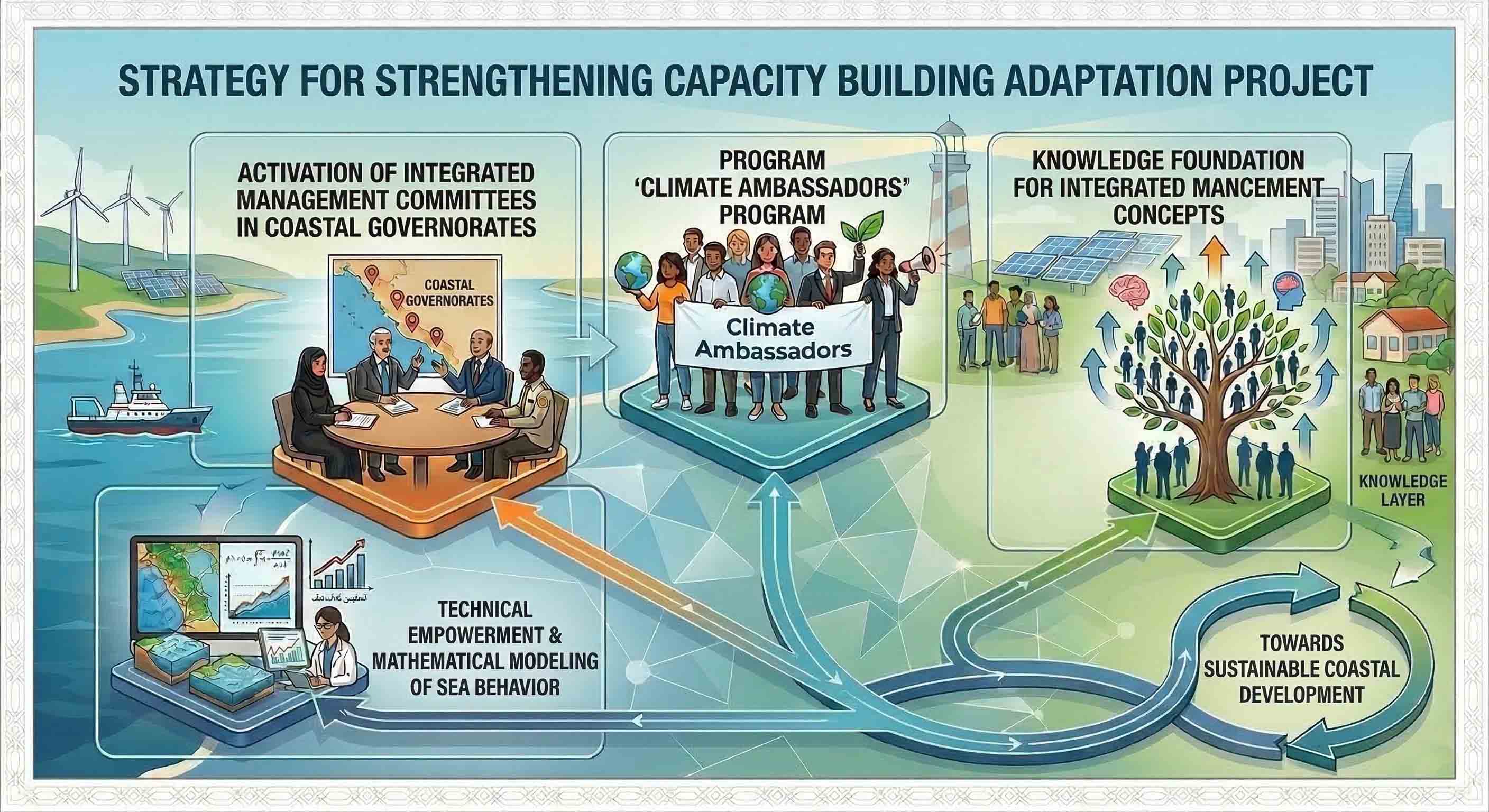
The project's strategy centers on embedding the institutional doctrine of Integrated Coastal Zone Management (ICZM) as a structural entry point to ensure the sustainability of developmental activities in coastal areas. It aims to address the "sectoral silos" phenomenon by merging divergent visions into a unified developmental framework based on the principle of participatory necessity. This stems from the conviction that genuine coastal development cannot be achieved in isolation from inter-sectoral coordination. In this context, the training program works on deepening the understanding of the interlinkages between various developmental activities—whether economic, environmental, or touristic—and their cumulative impacts on the coastal environment. This ensures the protection of natural resources and enhances the resilience of coastal zones against emerging challenges.
Technical Empowerment and Mathematical Modeling of Sea Behavior:
On the technical front, the project prioritizes empowering specialists with advanced forecasting and analytical tools through a package of specialized technical trainings. These sessions involve training engineers and researchers on utilizing mathematical models that simulate sea behavior, wave dynamics, and water currents. These digital tools provide officials with the capability to extrapolate future scenarios and assess the impact of surges and storms on the shoreline. Consequently, this supports informed developmental decision-making and the implementation of coastal protection works based on scientific foundations tailored to the specificities of each region.
The "Climate Ambassadors" Program and Human Capital Development:
The "Climate Ambassadors" program represents the heart and core pillar of the Integrated Management Plan. It is dedicated to building and qualifying national cadres, professionally trained to navigate the complexities and repercussions of climate change. The program's role transcends technical knowledge to include strategic investment in the employee's personal attributes and leadership skills, aiming to hone capabilities in effective communication, negotiation, and crisis management. This approach seeks to transform employees into proactive agents of change who champion climate awareness within their institutions, ensuring the preparation of a "Climate Ambassador" who possesses both technical literacy and personal resilience to serve as a professional bridge between scientific data and the coastal decision-making process.
Activating ICZM Committees in Coastal Governorates:
The capacity-building cycle is completed by focusing on decentralization through the training of ICZM Committees at the governorate level. The project focuses on providing technical and organizational support to these committees to ensure their ability to manage coastal areas within their local jurisdiction with high efficiency. The training covers strategic planning mechanisms, monitoring the implementation of integrated management plans, and the ability to interpret risk maps. This step ensures the translation of national strategies into tangible reality on the ground, supported by qualified local cadres equipped with the tools and mandates necessary to protect Egypt's coastlines.